
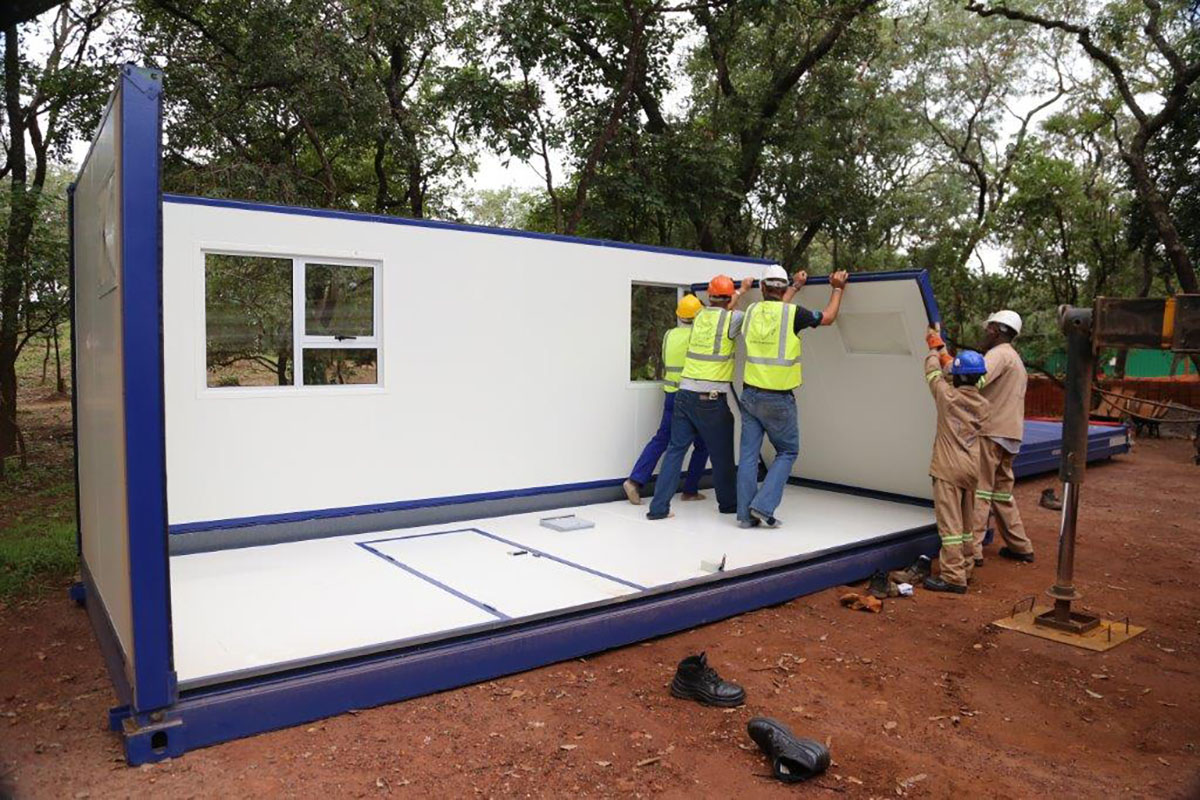
The growing use of modular police stations in South Africa demonstrates how this approach can do more than shorten construction timelines. By responding to the needs of each area, these projects can bring essential policing services closer to communities while creating opportunities for local employment, contractors, and practical skills development.
A police station is more than just a building; it is a vital connection to essential public services. The South African Police Service (SAPS) describes police-station infrastructure as a significant service-delivery improvement because it gives nearby communities access to policing services and provides a platform for safety and security.
Police infrastructure is about access
Distance becomes a safety concern when a community does not have a nearby police station. In The Oaks in Limpopo, SAPS reported that residents had previously needed to travel the long distance to Hoedspruit to open cases. The establishment of a local station brought services closer, allowing the police to react faster to security incidents.
This is where modular police stations in South Africa can offer a practical and cost-effective solution. SAPS reported that during 2024/25 it shifted part of its police-station programme towards an alternative construction method to fast-track prioritised stations and improve access to policing. As a result, six of the nine stations established that year used this alternative construction method.
Faster delivery with long-term infrastructure.
For modular police stations, fast implementation is one of the main reasons to consider modular construction, but speed does not mean a short-term structural solution. FSM’s SAPS project used units from its Polycore Fire Rated (FR)buildings, manufactured at its Germiston factory, transported to site, and assembled there. The buildings are designed for a lifespan exceeding 30 years, have a 30 minute fire rating to comply with municipal requirements and require minimal maintenance and servicing.
For the SAPS programme, the transported units were assembled within roughly three months. The wider project programme, however, included full operational site implementation: site clearance and earthworks, concrete foundations, building construction, services and final completion.
It is important to acknowledge that although modular construction changes how the building is produced and assembled, it does not remove the planning, engineering or infrastructure required around it. FSM’s listed project services include civil works, water and sewer services, stormwater, fire and mechanical services, electrical design, backup generators and essential infrastructure for IT connectivity..
Modular police stations in South Africa can create local opportunities
FSM employs local labourers to assist with erecting the modular buildings. They receive in-house training and, on completion of the project, are awarded a Certificate of Competence in Modular Construction.
Local participation can extend beyond the erection team. FSM also records the use of local contractors for work such as paving installation, brick perimeter walls, security and temporary ablutions. This means the project can combine specialist prefabricated construction with work sourced within the community where the station is being delivered.
This creates a wider impact beyond the infrastructure itself. The completed station may be the visible result, but the project also leaves behind practical experience and valuable skills that can continue benefiting local communities long after construction is complete.
From an empty site to an operating station
These projects are fully coordinated construction projects. FSM’s typical programme begins with site layout and design, followed by site clearance and earthworks. Concrete foundations are then installed before the buildings are constructed, and the site is completed. This is to ensure the longevity of the infrastructure.
The modular approach allows much of the polycore FR building system to be prepared away from the final site in a controlled manufacturing environment. FSM’s broader polycore FR system is an engineered structural insulated panel (SIP) solution manufactured for durability and long-term use. Once site preparation is ready, the manufactured components can be transported and easily assembled.
For public infrastructure, this process is beneficial as the objective is to get a functional facility into service as quickly as possible so that the community it is intended to serve can actually use it.
A footprint that reaches across provinces
FSM’s experience demonstrates how modular police stationsinSouth Africa can be delivered at scale. In just three years, more than 50 police stations have been completed across the country, including complete stations and Victim Friendly Facilities.
The project list spans the Western Cape, Northern Cape, Eastern Cape, Limpopo, KwaZulu-Natal, Mpumalanga, Free State and Gauteng. Examples include Makhaza and Dysselsdorp in the Western Cape, Majola and Tafalehashe in the Eastern Cape, The Oaks and Matlala in Limpopo, Sunrise View and Sonskyn in the Free State and Kwa Thema in Gauteng to name just a few..
Several of those locations also appear in SAPS reporting on its alternative building programme. This connects FSM’s completed projects to a broader public-service goal: expanding the policing footprint and bringing essential facilities closer to the communities that need them.
Frequently asked questions
How quickly can a modular police station be assembled?
Modular units can be transported to site and assembled within approximately three months. Total project duration, however, can be longer due to site works, foundations, services, and completion activities.
Are local workers involved in FSM police-station projects?
Yes, local labourers are employed to assist with erection, receive in-house training, and are awarded a Certificate of Competence in Modular Construction on completion. Local contractors may also be used for supporting works.
Are modular police stations in South Africa designed for long-term use?
FSM’s project material gives the modular buildings a projected life of more than 30 years with minimal maintenance and servicing. FSM’s current modular-building information also describes the system as suitable for both temporary and permanent applications.
Why use modular construction for police infrastructure?
The model can reduce the time needed to establish the building while retaining the engineering and services required for a long-term functional facility. SAPS has also used alternative construction methods as part of efforts to fast-track prioritised stations and improve community access to policing.
Speak to FSM about modular building requirements
FSM has supplied prefabricated and modular building systems across South Africa for over 90 years. To discuss modular police stations in South Africa, or any other public-sector, commercial or specialist modular building requirement, contact the FSM team.
Johannesburg (Head Office):011 821 5600
Cape Town (Atlantis):021 577 1156
Eastern Cape (Mthatha):072 646 9581
Visit us at www.fsm.co.za to learn more.